
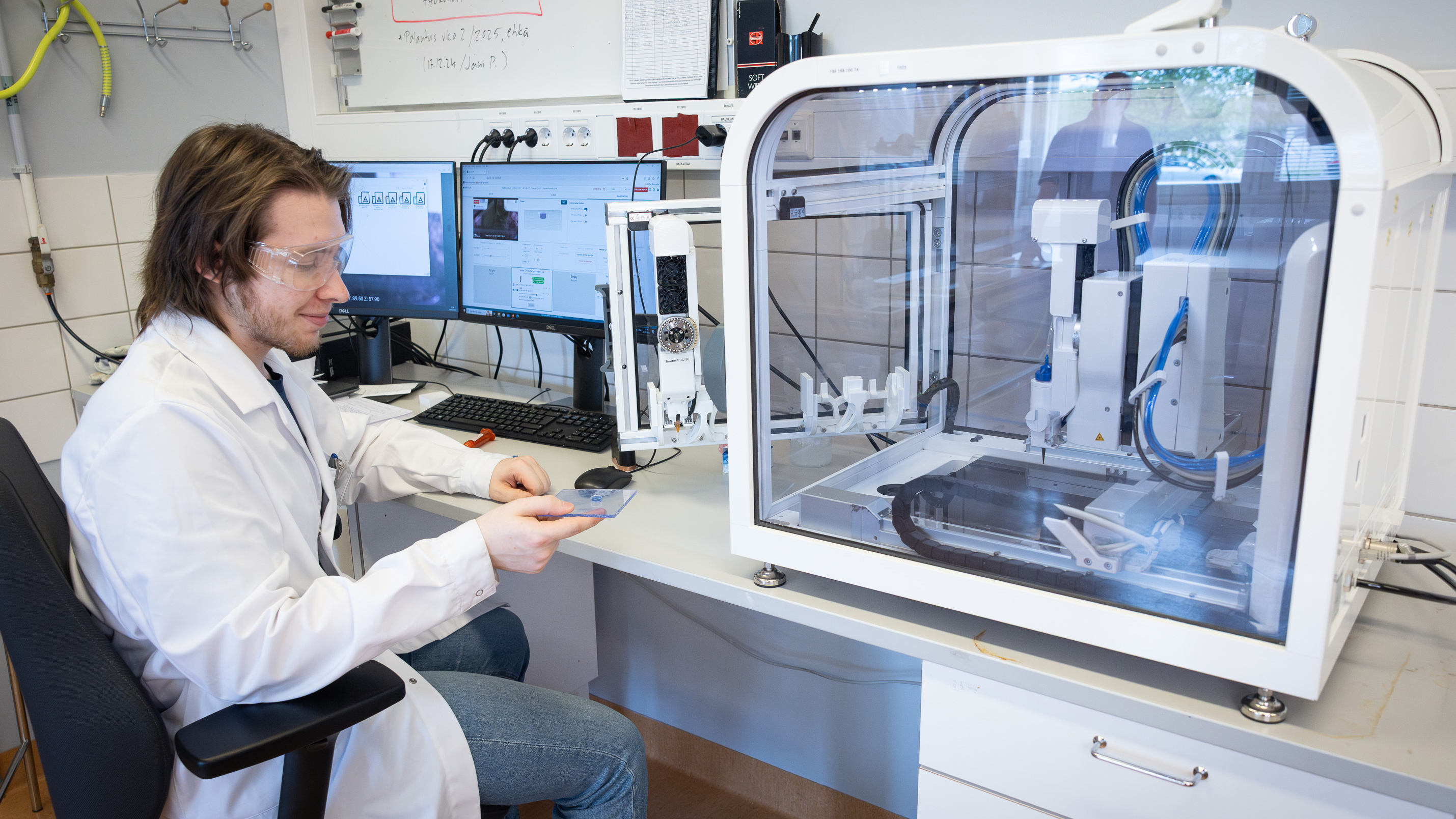
A medicine tailored just for you in terms of dose, form, solubility and even taste, made in a local pharmacy according to a doctor’s prescription? This is possible, at least in theory and to some extent in practice, thanks to 3D printing technology. The 3D-CURE project is exploring this topic.
Published:
Edited:
Text and photos by Martti Komulainen
3D printing of medicines is not new – it has been studied for a dozen years. Through a start-up company, “ex-tempore” 3D printing has already been tried in Finland in a few pharmacies as a service for vascular and NSAIDs for specific customer groups.
Still in the research and development phase
– It cannot be said that 3D printing of pharmaceuticals is yet an actively used operating model, but we are still in the research and development phase, summarises Lecturer Jani Pelkonen from the New Materials and Processes research group.
There are still many unanswered questions and 3D printing as a technology has not yet caught up more widely with traditional pharmaceutical manufacturing technologies. There are many reasons: mass production is obviously a more cost-effective way to manufacture medicines. Also, encapsulating many drugs in 3D is challenging. The tight regulation of pharmaceutical manufacturing is a further delay in development.
Turku UAS conducts solubility research on medical implants
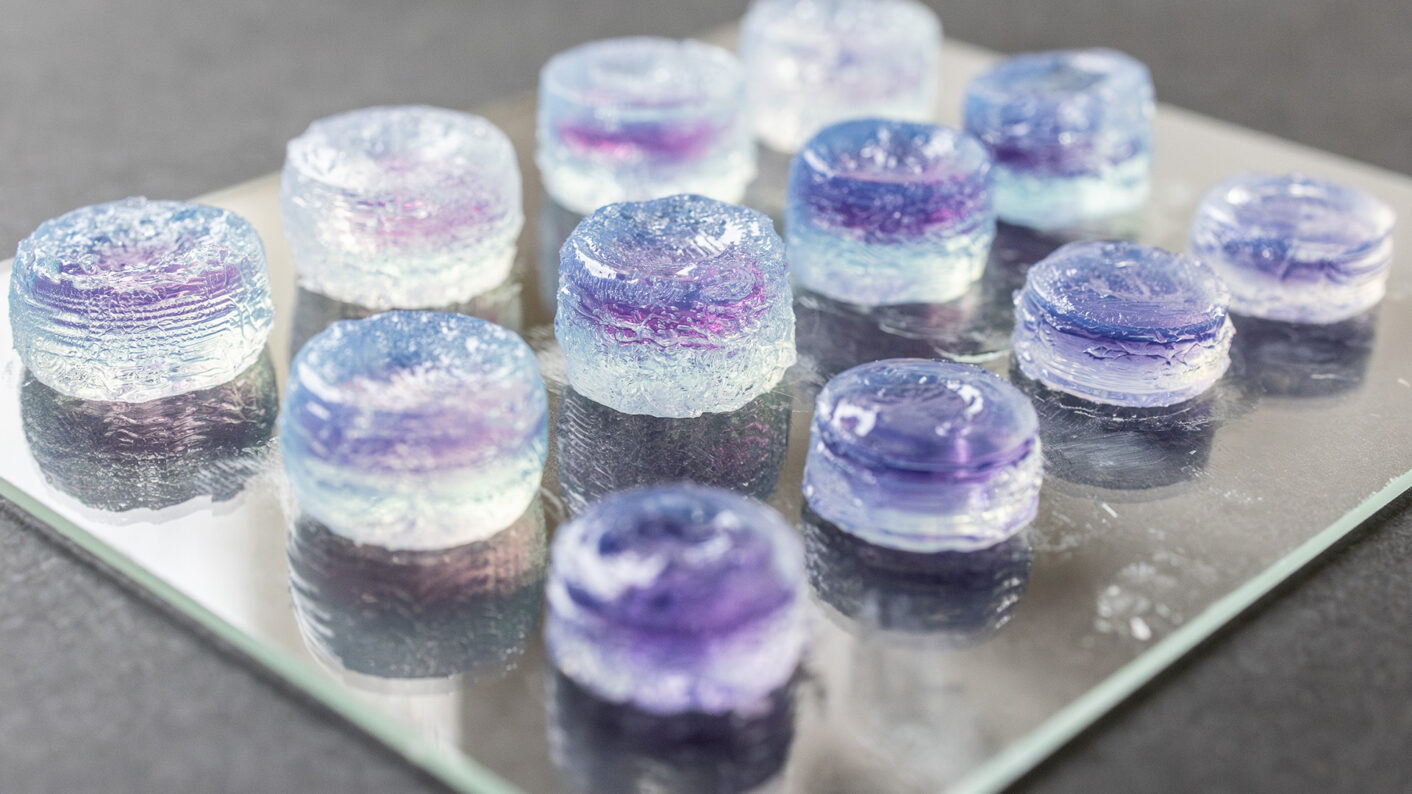
At the Turku University of Applied Sciences, the focus has been on the solubility of drug implants (drug inside the scaffold). Another line of research is related to the study of the properties of 3D-printed pharmaceuticals by mathematical modelling using so-called digital twins, i.e. virtual counterparts of real objects.
– By adjusting solubility, the release of the drug can be optimised, says Jani Pelkonen, emphasising the importance of solubility studies.
– In its simplest form, the drug implant (carrier and drug) is placed in 37°C water (37°C simulates the internal temperature of the human body) and the concentration of the active substance is measured at intervals, explains lecturer Juha Nurmio.
The drug in the appropriate carrier material allows precisely this solubility to be adjusted. The carrier can be porous, in which case the small molecule drug is released from the pores, or the carrier can be slowly soluble. Solubility is influenced by factors such as the surface area to volume ratio and the shape of the carrier.
Both small molecules and protein-based drugs are being investigated. The study does not focus on a specific drug substance, but provides a basis for investigating different types of drug-carrier combinations.
The 3D-CURE project brings together four different research organisations and several companies. The project is led by Turku University of Applied Sciences. Åbo Akademi, the University of Turku and Lappeenranta-Lahti University of Technology, together with Bayer, Brinter, Gasera, CH-BioForce, UPM Biomedicals, Rokote Laboratories, DelsiTech and EDR & Medeso, form a consortium that aims to develop a new way of designing personalised medicine based on data and models, and to industrialise the manufacturing process through 3D printing testing of different materials.
Visit
Read next
-
Phenomenon
Heat Storage from Industrial Waste
Utilizing and storing waste heat can solve many problems related to energy demand and climate change. Additional benefits would arise if industrial byproducts and construction waste—which would otherwise…
-
Press Release

A solar power calculator developed by Turku University of Applied Sciences helps users estimate the cost-effectiveness of solar panels for generating electricity at home
A solar power calculator developed by researchers helps buyers of solar panels assess the profitability of their investment. Generating your own solar power provides security, for example, during…
-
Press Release
A €7 million EU project coordinated by Turku University of Applied Sciences is set to overhaul quality and safety controls in poultry production across Europe
The Sensor4Food project, coordinated by Turku University of Applied Sciences, is developing photonics-based sensor technology for quality control in poultry production. The solutions are being tested in Spain,…