
A project at Turku University of Applied Sciences is developing a testing environment suitable for battery testing, which will provide additional information on battery behavior under extreme conditions, their aging, and their performance in various situations.
Published:
Edited:
A relatively small shipping container will play an important role going forward. Inside it, various batteries can be tested to their absolute limits under safe and controlled conditions. This provides information on how batteries can be made even safer.
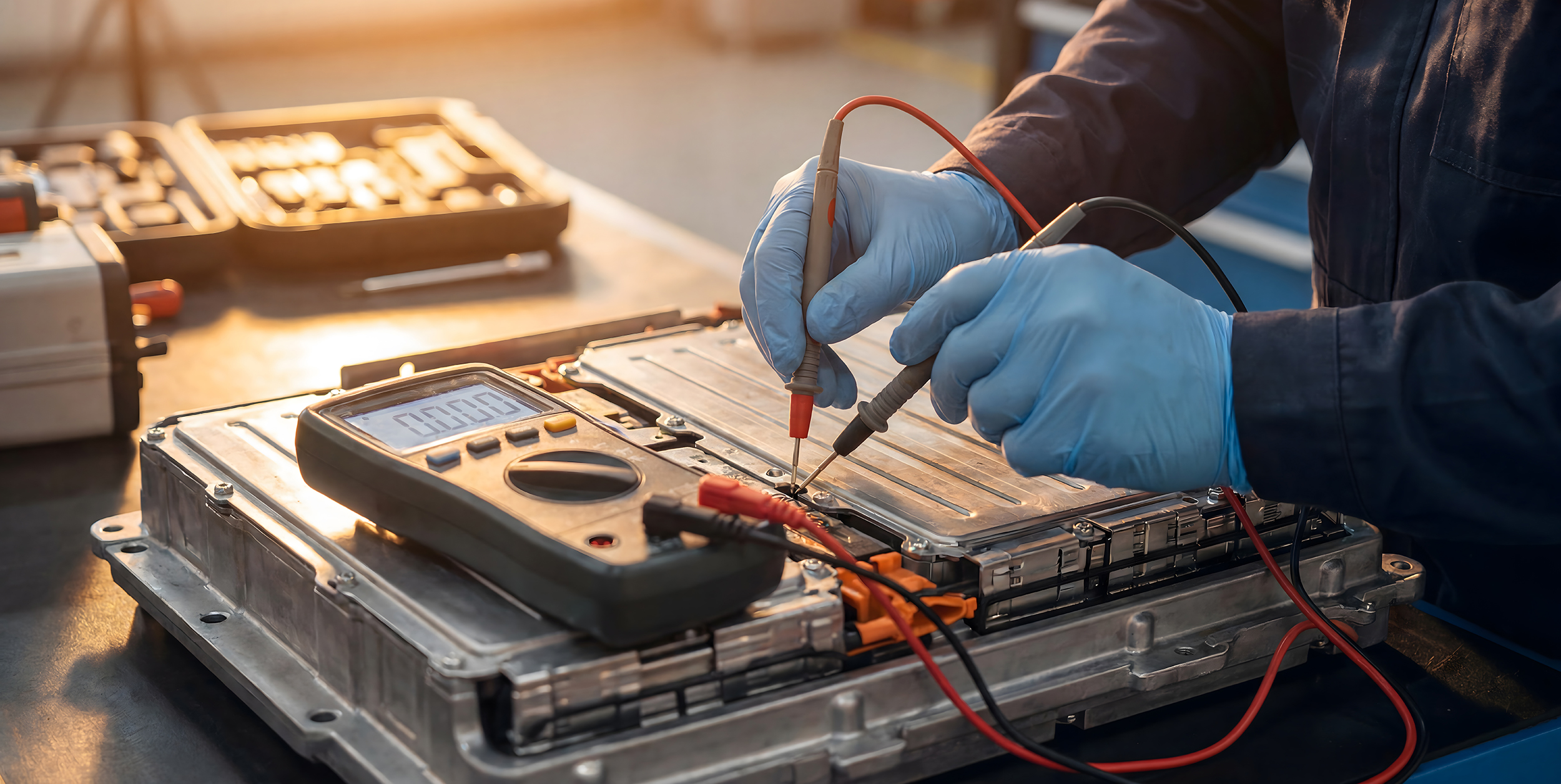
Battery Destructive Testing – RIKKOVA project involves designing and implementing a testing platform at Turku UAS’ Kupittaa campus for the safe testing of batteries under extreme electrical conditions or under heavy mechanical load. The goal is to produce higher-quality data in the future to support simulation and product development.
− The project originally stemmed from a need for testing: we realized that we couldn’t subject the batteries to extreme conditions, which meant we couldn’t obtain real measurement data that could be used in battery simulation, design, and the development of safety solutions, explains Joonas Pekkarinen, Senior Lecturer at Turku UAS.
The Manufacturing Engineering and Computational Engineering and Analysis (COMEA) research groups at Turku UAS decided to build a test cabinet for this purpose.
− A safe testing environment allows us to conduct extreme-condition testing, which enables us to develop safer battery solutions. If a battery catches fire during testing, it’s not a disaster—we can control the fire within the testing environment, says Pekkarinen.
There are many reasons for analyzing batteries: the goal is to gain a better understanding of how batteries perform under extreme conditions, such as mechanical damage or short circuits—whether external or internal to the cell. In addition, the testing environment can provide valuable measurement data on battery aging and how aging affects battery performance and safety.
New types of so-called “second life” applications can also be developed for batteries. When electric vehicle batteries reach the end of their useful life, they are no longer considered suitable for use in vehicles. Instead of being sent for recycling, they could serve, for example, as energy storage devices.
− To make this possible, we need better ways to analyze and measure used batteries, and above all, to develop solutions for verifying battery safety. The testing environment being built to meet that need addresses this, Pekkarinen says.
From electric bike batteries to vehicles
Turku UAS is involved in a wide range of projects related to energy and batteries. These various projects can utilize the test cabinet for their research. If there is a need to develop battery products or test safety solutions, Turku UAS will be able to provide a testing platform for this in the future.
The test cabinet can be used to test everything from small consumer electronics batteries, such as those found in scooters and electric bicycles, to moderately sized vehicle modules with a maximum capacity of approximately 300 ampere-hours.
− Unlike standard tests, the cabinet is designed to serve as a research platform on which various test setups can be built as needed. For example, we can use the cabinet to test overcharging and see how long the battery lasts. Or, for example, we can intentionally set a single battery cell on fire and figure out how to contain the fire so that the entire car doesn’t burn. We want to understand how batteries function in extreme situations, Pekkarinen explains.
The Battery Destructive Testing – RIKKOVA project is co-financed by the European Regional Development Fund. The project’s total budget is just over 370,000 euros. The 2.5-year project will conclude in the summer of 2027.
The Manufacturing Engineering Research Group at Turku University of Applied Sciences focuses on solving problems in the manufacturing industry. Learn more about the research group
The Computational Engineering and Analysis (COMEA) research group has systematically developed its expertise in battery system modeling through several large-scale research projects since 2018. Learn more about the research group




Get to know
Read next
-
Case

Mathematical modelling can be used to design dentures
Mathematical modelling has many practical applications. Rabia Altunay, a researcher in the Computational Engineering and Analysis (COMEA) research group at…