
Enhancing battery repairability, diagnostics, and reuse (AkkuSus)
Duration of the project
Source of funding
European Regional Development Fund (ERDF)

Total funding
447 030 €
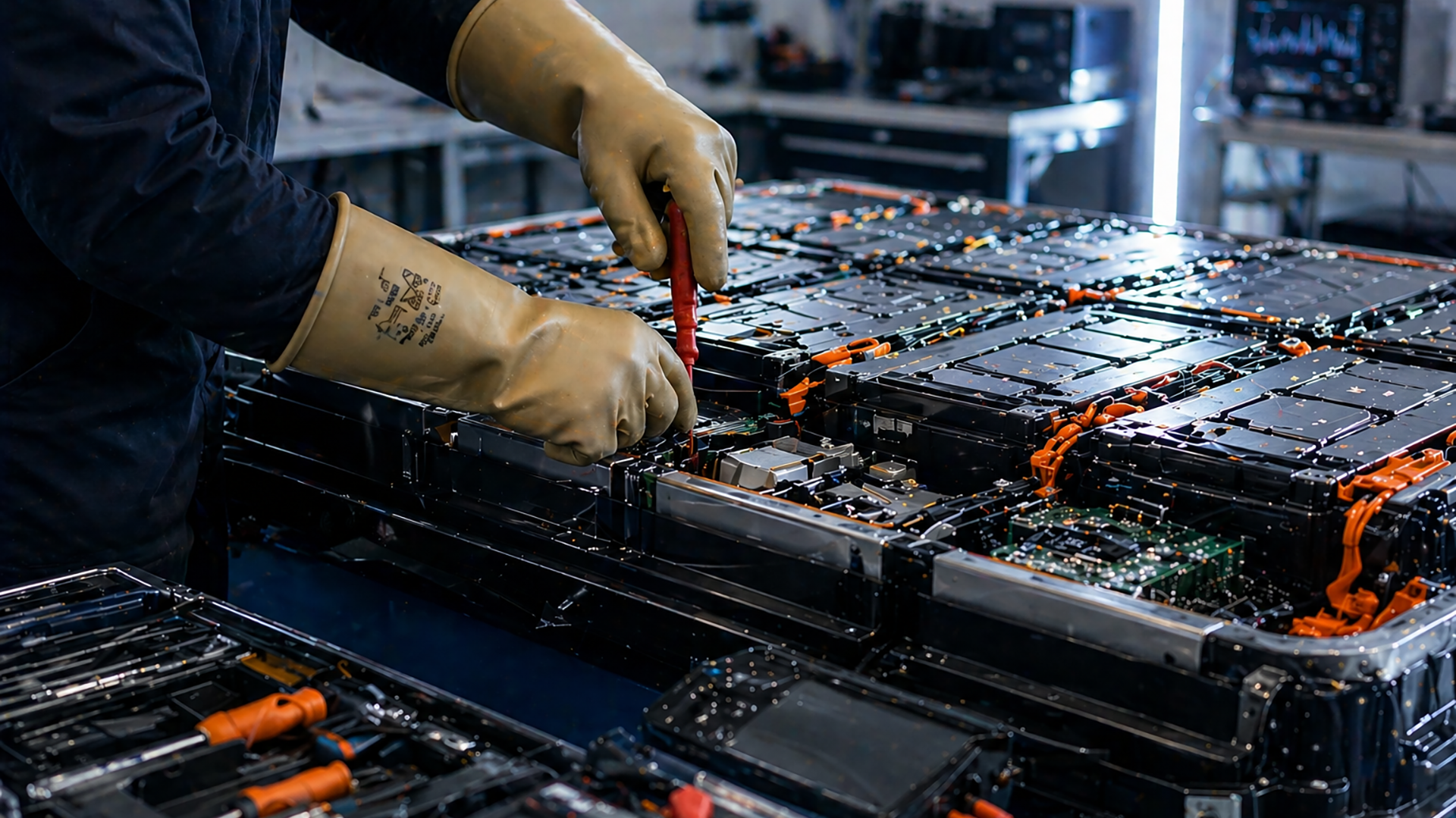
The rapid increase in the number of electric and hybrid vehicles creates a need to extend the service life of traction batteries, particularly through repair and reuse. The new EU Battery Regulation strengthens the requirements for promoting the circular economy, but the maintenance, repair, and reuse business for used batteries is still very limited. The goal of the project is to develop solutions that make batteries repairable, economically viable, and environmentally sustainable, while supporting companies in Southwest Finland in creating new business opportunities.
In the first half of 2025, approximately 870,000 electric cars and around 2 million hybrid cars were sold in the EU area. The EU Battery Regulation, which entered into force in August 2023, aims to improve the circular economy of lithium-ion batteries (hereafter: batteries), ensure responsible battery supply chains, and strengthen the EU’s competitiveness in the battery industry.
The resale value of electric cars decreases very rapidly. Defect and worn-out batteries are neither repaired nor serviced. Batteries are not sorted according to the severity of defects. Diagnostics are incomplete. Batteries are designed solely for their original purpose and as non-repairable. This makes the situation economically and ecologically unsustainable on a global scale.
The main objective and business potential of the project in Southwest Finland
The primary objective of the project is to help companies in Southwest Finland to gain new business in battery repair, maintenance, diagnostics and reuse. The aforementioned battery business is absent, although the business potential is considerable. We will be in practical cooperation with the car repair shops and the battery industry in Southwest Finland.
Another aim is to map the entire battery economy network and its needs: vehicle battery design, manufacturing, repair, reuse, dismantling of End-of-Life (EoL) batteries, recycling, and the implementation of the new EU Battery Regulation (2023/1542). In addition, the EU Ecodesign Directive (2009/125/EC) established a framework for the ecological design of energy-related products. We will create a concept that supports long battery lifespans, prevents waste generation, and reduces the environmental footprint of electric mobility. Product design is the true enabler for realizing the circular economy of batteries.
The importance of reusability, repairability and diagnostics
The reuse of batteries and their sustainable design should also be economically viable. Issues of responsibility and warranty, along with a lack of expertise and courage, have hindered the emergence of new SME businesses around battery repair and maintenance. The diagnostics of used electric vehicle batteries is not yet fully comprehensive or reliable. We aim to provide ideas and expertise for entirely new business opportunities for SMEs in Southwest Finland. From the very beginning, we will collaborate with, among others, car repair shops.
A battery must be adequately designed to be repairable and reusable. A battery must be diagnosed before repair or reuse. Repair may require disassembly, and recycling requires partial dismantling. The Battery Regulation, in turn, sets legislative requirements for the possibility of battery reuse and the feasibility of repair from a design perspective.
Target groups and cooperation across the battery value chain
The target group of the project consists of all actors across the entire battery value chain, including product designers, battery manufacturers, repair providers, reuse operators, and those responsible for dismantling and recycling. The project requires cooperation with actors such as car dismantlers and battery recycling plants. In addition, the project aims to engage indirect stakeholders, such as governmental regulatory authorities, extended producer responsibility organizations, and insurance companies. Through insurance companies, a significant driving force for the circular economy, especially for battery repairability, can emerge. For consumers, insuring a car model becomes cheaper when the battery is easily and cost-effectively repairable. Thus, consumption can be steered towards more responsible products through circular economy principles and market mechanisms.


Contact us

Meet the research team
-
Research teams
Manufacturing Engineering
-
Research teams
Circular Business Models
See all our projects
We carry out nearly 200 RDI projects annually together with working life and our international partner networks.