
HEATWISE – Advanced Heat Energy Tools for Widespread Adoption by Industrial SMEs
Project duration
Source of funding
Business Finland co-research
Flexible Energy Systems Program
Total funding
617 422 €
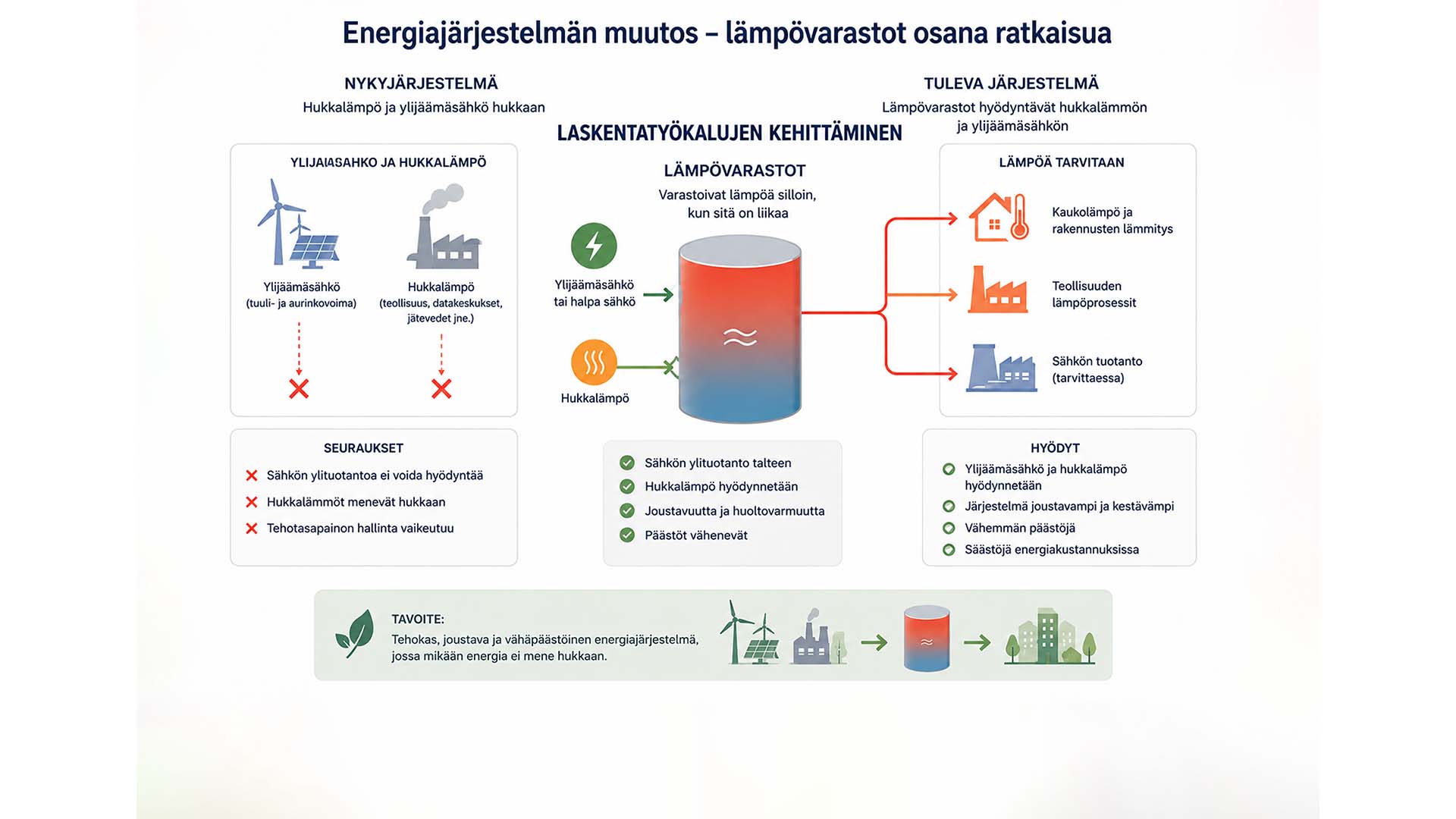
Thermal energy storage is emerging as a key component of the energy transition. TES systems enable the utilization of renewable energy, the recovery of waste heat from industry and data centers, and the balancing of fluctuations between energy supply and demand. In Finland, thermal energy storage capacity is growing rapidly in both large-scale industrial applications and decentralized building-level solutions, creating significant opportunities to improve energy efficiency and develop new business models. The HEATWISE project develops computationally efficient models for TES systems that capture the essential thermal, fluid-flow, and structural phenomena at a fraction of the computational cost of full 3D simulations.
The Role and Development of Thermal Storage
Thermal Energy Storage (TES) systems enable surplus energy, such as renewable electricity, solar heat, or industrial waste heat, to be stored and utilized when needed. In Finland, TES technologies range from hot-water tanks and pit thermal energy storages for short-term applications to underground thermal energy storages (uTES), such as borehole thermal energy storage (BTES), for seasonal storage. Rapid growth in renewable energy production, waste heat recovery, and energy market flexibility has significantly increased interest in TES solutions. Examples include the 90 GWh cavern thermal energy storage under construction in Vantaa, industrial-scale waste-heat storage concepts, and emerging modular and high-temperature TES technologies for buildings, campuses, and district heating networks. At the same time, Finland hosts growing volumes of recoverable waste heat from industry and data centers, creating substantial business opportunities for TES deployment.
Implementation Challenges in Space-Constrained Environments
Despite this progress, several challenges limit wider adoption of TES systems, particularly among small and medium-sized enterprises (SMEs). One key challenge is implementing TES in space-constrained urban and industrial environments. Borehole fields, energy piles, and other storage concepts must often be designed within narrow physical boundaries while maintaining thermal performance, structural integrity, and operational reliability. Deep boreholes offer increased storage capacity but also introduce uncertainties related to pressure, temperature, and material durability.
Shortcomings of design tools
Another major challenge is the lack of affordable and computationally efficient design tools. TES systems are highly site-specific, with performance depending on local geology, energy demand profiles, storage geometry, and operating conditions. Existing design approaches typically rely either on simplified analytical methods that cannot accurately capture long-term behavior or on computationally intensive three-dimensional simulations that are too slow and expensive for routine design optimization. As a result, many SMEs lack practical tools for evaluating novel concepts, optimizing designs, and reducing technical risks.
Increased demand for cooling and market changes
The growing need for cooling further increases complexity. Thermal storage systems are increasingly expected to provide both heating and cooling services, enabling seasonal energy balancing and improved infrastructure utilization. Simultaneously, volatile Nordic energy markets create strong incentives for flexible TES operation. Electricity price fluctuations, reserve market participation, and evolving district heating business models require storage systems to operate dynamically and respond to changing market conditions in real time.
Solutions from the HEATWISE project
Addressing these challenges requires advanced design and decision-support tools that combine high accuracy with computational efficiency. The HEATWISE project aims to bridge the gap between the rapidly evolving needs of the TES industry and the capabilities of currently available modeling approaches. By developing computationally efficient surrogate models, reduced-order models, and optimization tools, HEATWISE will enable industry stakeholders to design, optimize, and operate next-generation TES systems more effectively. In doing so, the project will support innovation, reduce barriers for SMEs, and accelerate the adoption of thermal energy storage technologies in the future low-carbon energy system.

Contact us


Partners
- AccuHeat Oy
- Ailea Oy
- Tekres Group Oy
- Osakeyhtiö lamit.fi
- QHeat Oy
- Debe Suomi Oy
- Rototec Oy
Learn more about the research group
-
Research Groups
Computational Engineering and Analysis
See all our projects
We carry out nearly 200 RDI projects annually together with working life and our international partner networks.